Reconstruction of a High-Tension Post-Mohs Defect with Bilateral Rhombic Transposition Flaps and Double Z-Plasties: A Case Report
Keywords:
Mohs Micrographic Surgery, infiltrative basal cell carcinoma, rhombic flap, z-plasty, plastic surgery, reconstructive surgeryAbstract
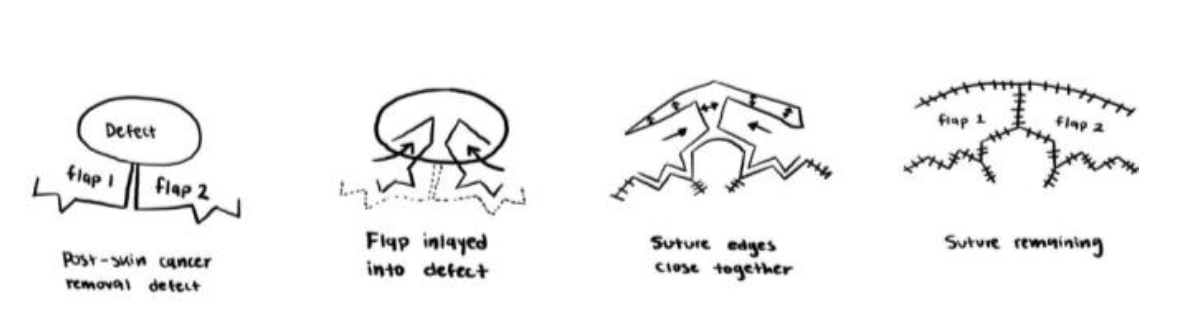
Large defects on the upper back may be difficult to reconstruct effectively due to the highly tensile and inelastic qualities of local skin. Moreover, some patients tend to have kyphotic curvature of the spine, which can exacerbate the tensile forces on a primary closure. We present a post-Mohs surgical case of a mid-central back defect managed using bilateral rhomboid transposition flaps, each with double Z-plasties. This approach allowed for complete redirection of tension vectors and provided the necessary tissue laxity for optimal wound closure. The incorporation of Z-plasties facilitated skin lengthening during flap rotation, enhancing the overall reconstruction. Postoperatively, the patient achieved complete wound healing without complications. This technique demonstrates the positive effect of combination transposition flaps in addressing complex defects in areas with limited tissue availability.
Downloads
Published
Issue
Section
License
Copyright (c) 2026 Harib H. Ezaldein, MD, Mona Ibrahim, Amna Ibrahim (Author)

This work is licensed under a Creative Commons Attribution-NonCommercial-NoDerivatives 4.0 International License.
Authors of all original research published in the Journal of Skin Cancers, Conditions, Aesthetics, and Reconstructive Surgery (JSCARS) retain full copyright in their articles while licensing the journal to publish the content as the original venue of publication. To maximize global impact, all articles are made available immediately and permanently free to access online under a Platinum Open Access model, permitting any user to read, download, copy, distribute, print, search, or link to the full texts, crawl them for indexing, or pass them as data to software for any other lawful purpose. Permitted reuse is defined by the Creative Commons Attribution 4.0 International (CC BY 4.0) license, which lets others distribute, copy, remix, transform, and build upon the work—including for commercial purposes and the creation of derivative works such as translations or anthologies—as long as they provide proper credit to the original author(s) and JSCARS, link to the license, do not suggest endorsement by the author, and do not modify the article in a manner that damages the author's honor or professional reputation. Digital production and global discoverability support for JSCARS are provided by Open Journal Systems (OJS).


