The Cutaneous Mycobiome in the Follicular Occlusion Tetrad: Evidence, Mechanisms, and Clinical Implications
Keywords:
skin mycobiome, follicular occlusion tetrad, hidradenitis suppurativa, fungal dysbiosisAbstract
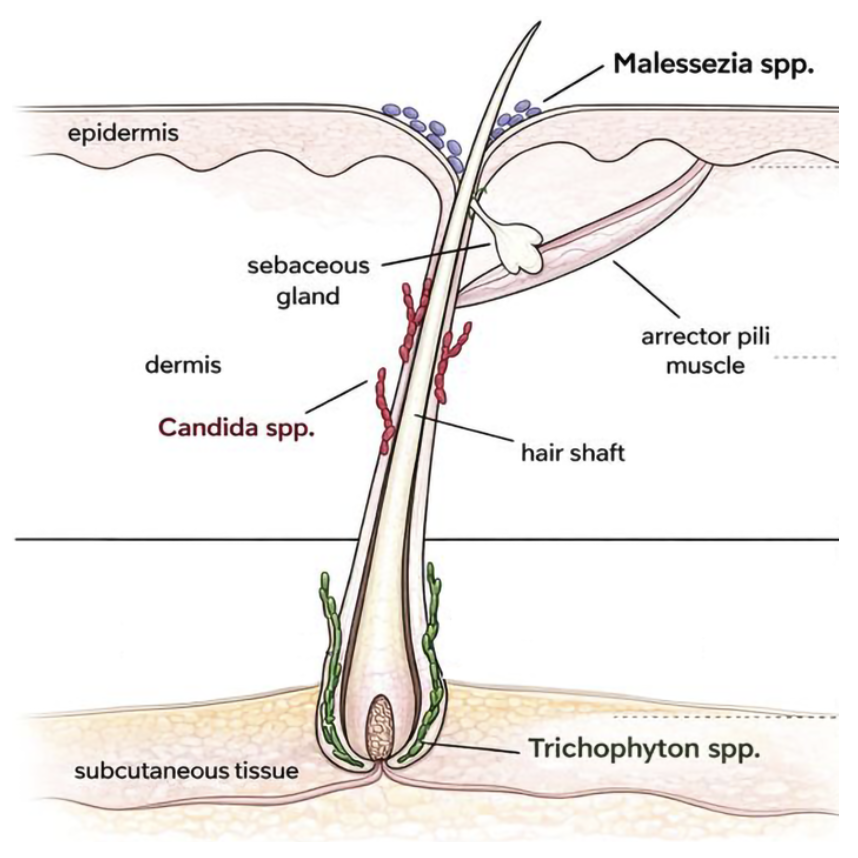
The cutaneous mycobiome is an underexplored component of the skin microbiome with potential relevance to chronic inflammatory follicular disorders. While bacterial dysbiosis has been extensively studied, the contribution of fungal organisms to follicular occlusion diseases remains incompletely defined. This narrative review examines available evidence regarding fungal involvement in the follicular occlusion tetrad, including hidradenitis suppurativa, acne conglobata, dissecting cellulitis of the scalp, and pilonidal sinus. Across these conditions, fungi (most commonly Malassezia and Candida species) are detectable within follicular units but are not consistently enriched in lesional skin. Current data suggest that fungi function primarily as secondary colonizers, inflammatory modifiers, or diagnostic mimickers rather than primary pathogenic drivers. Evidence supporting a direct fungal role is most limited in pilonidal sinus disease and more frequently involves clinical mimickers in dissecting cellulitis and acne conglobata. Notably, immune pathways implicated in follicular occlusion disorders, including Th17-mediated and interleukin-17 signaling, also play central roles in antifungal host defense. Therapeutic modulation of these pathways may therefore influence fungal susceptibility. Overall, existing evidence does not support a primary pathogenic role for fungi but highlights their potential relevance in select clinical contexts.
Downloads
Published
Issue
Section
License
Copyright (c) 2026 Garrett Kraft, BS, Amna Ibrahim, BS, Mona Ibrahim, BS, Harib H. Ezaldein, MD (Author)

This work is licensed under a Creative Commons Attribution-NonCommercial-NoDerivatives 4.0 International License.
Authors of all original research published in the Journal of Skin Cancers, Conditions, Aesthetics, and Reconstructive Surgery (JSCARS) retain full copyright in their articles while licensing the journal to publish the content as the original venue of publication. To maximize global impact, all articles are made available immediately and permanently free to access online under a Platinum Open Access model, permitting any user to read, download, copy, distribute, print, search, or link to the full texts, crawl them for indexing, or pass them as data to software for any other lawful purpose. Permitted reuse is defined by the Creative Commons Attribution 4.0 International (CC BY 4.0) license, which lets others distribute, copy, remix, transform, and build upon the work—including for commercial purposes and the creation of derivative works such as translations or anthologies—as long as they provide proper credit to the original author(s) and JSCARS, link to the license, do not suggest endorsement by the author, and do not modify the article in a manner that damages the author's honor or professional reputation. Digital production and global discoverability support for JSCARS are provided by Open Journal Systems (OJS).


